Showing posts with label Odds and bobs. Show all posts

Friday, 25 June 2021

Courtesy titles of the children of disclaimed Peers

 Continuing my sojourn into back copies of The Coat of Arms, in a letter (Volume XII No. 86 April 1971) Patrick W. Montague-Smith, Editor, Debrett, reminds us that:

Under the Peerage Act a disclaiming peer irrevocably divests himself and his wife "of all right and interest to or in the peerage, and all titles, rights, offices and privileges and precedence attaching thereto." That the children are unaffected, retaining their precedence, was made clear in a statement issued by Garter King of Arms. The Earl Marshal, after taking the advice of Norfolk Herald Extraordinary and the Lord Lyon King of Arms, stated that they should continue to be accorded courtesy titles unless they do not wish to use them. The use of courtesy titles and styles, is, of course the Sovereign's prerogative.


Referring to Albertus Magnus' letter (Vol. No. 79, p 257) the Foreign Secretary undoubtedly ranks as a Secretary of State under Baronial Rank. His son, the former Lord Dunglass, obtained recognition at Lyon Court in his new name of D. A. C. Douglas-Home, Esq., before Garter's statement was issued, but in view of the above he retains precedence as the eldest son of an Earl.

The coronet of a Baron in the peerage.

The comments in the letter refer to David Douglas-Home who, upon the death of his father, who had disclaimed his peerage, became 15th Earl of Home.


The arms of the Earl of Home: Image by Wikimandia 


Quarterly: 1st & 4th grandquarters, quarterly: I & IV: vert a lion rampant argent armed and langued gules (Home); II & III: Argent three popinjays vert beaked and membered gules (Pepdie of Dunglas); overall an escutcheon or charged with an orle azure (Landale); 2nd & 3rd grandquarters, quarterly: I: Azure a lion rampant argent armed and langued gules crowned with an imperial crown or (Lordship of Galloway); II: Or a lion rampant gules armed and langued azure debruised of a ribbon sable (Abernethy); III: Argent three piles gules (Lordship of Brechin); IV: or a fess checky azure and argent surmounted of a bend sable charged with three buckles of the field (Stewart of Bonkill); over all on an inescutcheon argent a man's heart gules ensigned with an imperial crown proper and a chief azure charged with three mullets of the field (Douglas).


Wednesday, 9 June 2021

A despicable fake

I came across this (undated) letter, purporting to be from Garter King of Arms while searching for something quite unrelated. It is such a despicable fake that it just has to be exposed. 

It would seem that this individual has a desire to claim the arms (and Lordship of the Manor) of Baguley despite the fact that the (heraldic) family of Baguley (those believed, but not proved, to have been descendants of Hammon de Massey) are extinct. Certainly the Hall came to the Leighs of Booths via an heiress. The arms are also quartered by Fritton. It is likely that most, if not all, of those with this name today have what is known as a location surname i.e. at the time surnames were adopted they lived in or were from the village, rather than being descendants of the extinct manorial lords.

I placed this fake letter on the Facebook forum of The Heraldry Society and participants in the discussion did a wonderful job of dissecting the elements which exposed it as a fraud. 


Quite apart from the different fonts used, we start with the word "apologize" with a "z". Englishmen tend to use apologise with an "s". But what is the apology for? It appears that Garter is apologising on behalf of York Herald for his lack of knowledge of Thomas Woodcock and his research in the Oxford Guide to Heraldry. I simply don't believe that  York would be ignorant of either the man or his works; this is too incredible to be believed. The comment about any case "in heraldic court" (not in the heraldic court or the Court of Chivalry) is also quite ridiculous as Garter would, if he wished to discuss a case to be brought before the Court of Chivalry, have mentioned his own view that any resurrection of the Court would be practically impossible and he would have cited comments made at the Manchester case.
Garter would know full well that in his judgement (Manchester Corporation v Manchester Palace of Varieties [1955] P 133) Lord Goddard suggested that: “if this court is to sit again it should be convened only where there is some really substantial reason for the exercise of its jurisdiction.” Someone wishing to prove a right to arms would do so by having his pedigree examined by The College, not by bringing a case before the Court of Chivalry. 

The reference to the Earl Marshal as "his grace" in lower case does not further convince us that this letter is genuine.

The next part is meaningless waffle but it is clumsy to write "bare" arms when the real Garter would know full well that a person bears arms. When a person is seeking to prove a right to bear arms, no garter would write, without substantial proof, and suggest that the petitioner simply accept his recognition as head of the family and the bit about nobility is meaningless to an English King of Arms. To suggest that there is a need to simply "accept my recognition and leave the matter alone" (implying that it would be too much trouble to do anything else)  is risible. 

Those of us with any smattering of knowledge about these things would know that anyone claiming the right to bear arms and writing to the College of Arms for guidance would be informed of a proper process, involving a proven genealogy, by which that right must be claimed and we know that the College of Arms would offer, for a fee, assistance in either proving or disproving the claim. The Court of Chivalry would not come into the discussion, nor would any herald suggest anything, without proof, which would indicate a sort of "its far too much trouble to go to these lengths so lets just say that you are the head of your American family and you can use the arms with some cadency marks, call yourself Esquire and be a nobleman"! 

Oh, and we don't end a letter with Yours Sincerely with an upper case S. It should be Yours sincerely.

What an utterly despicable, illiterate, effort to pretend to be something that you are not.   
 

Thursday, 22 April 2021

Certificate of Robert Earl of Essex concerning Richard Jenyns

I stumbled upon this by accident whilst looking for something else. It has an heraldic interest (from the Records of the Cheshire Quarter Sessions).


Tuesday, 13 April 2021

Heraldic Puns abound in Cheshire

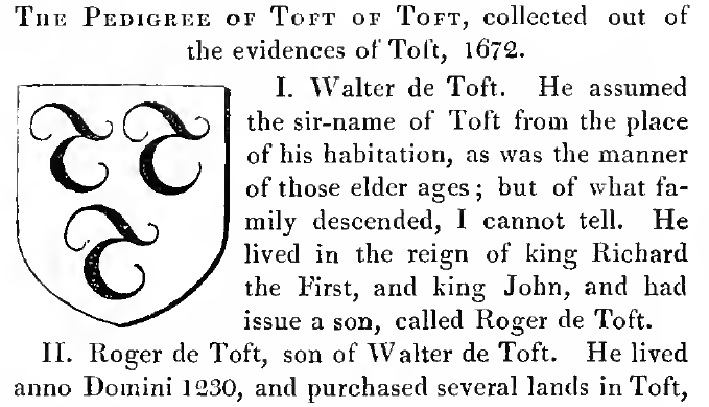
We all like a good heraldic pun and one of my favourites is the arms of Toft. 


The Tofts of Toft, a very ancient Cheshire house, charged their silver shield with a black chevron and three text T's of the same, the T oft repeated being an exact representation of their name. 

Addendum:
Extracts from Ormerod's History of Chester illustrating that the original Toft of Toft coat did not have the chevron.


Heraldic Puns abound in Cheshire - Lupus

Hugh Lupus

Azure, a wolf's head erased Argent.

The famous arms attributed to Hugh Lupus are perhaps in the first division of heraldic puns even though this great Domesday earl was not really armigerous in the sense in which we understand the term however, once we accept that these arms are attributed, they must stand as a most dignified representation of an heraldic pun 

Attributed coat of arms of Hugh d'Avranches, Earl of Chester (Hugh Lupus)


Thursday, 1 October 2020

Medieval flags, Campbell, Colin, Good Condition Book

 Medieval flags, Campbell, Colin, Good Condition Book


Medieval flags, Campbell, Colin, Good Condition Book,. Condition is "Good". Dispatched with Royal Mail 2nd Class.


33 page booklet published by The Heraldry Society of Scotland. An essay on Medieval flags written by Colin Campbell.

Note there is a very slight print stain on the front cover (it's been there from new). Please satisfy yourself from the photo.

Heraldry Gazette (1978 to 1985) Early copies (17 in all) of The Heraldry Gazette

I have quite a few duplicates in my library accumulated over the years so I'm starting to have a general clear out. Postage is perhaps prohibitively expensive for international sales though so I'm starting with the small stuff.

Heraldry Gazette (1978 to 1985) Early copies (17 in all) of The Heraldry Gazette

Heraldry Gazette (1978 to 1985) Early copies (17 in all) of The Heraldry Gazette. Condition is "Acceptable". Dispatched with Royal Mail 2nd Class.


Early copies (17 in all) of The Heraldry Gazette, Newsletterof The Heraldry Society.


Black and white pamphlet style early editions.

Number 74 August 1978

Number 78 August 1979

Number 79 November 1979

Number 80 February 1980

Number 81 May 1980

New Series II August 1981

New Series III November 1981

New Series V May 1982

New Series VII November 1982

New Series VIII February 1983

New Series X December 1983

New Series XI March 1984

New Series XIII Sept 1984

New Series XIV December 1984

New Series XV March 1985

New Series XV June 1985

New Series XVII September 1985


Wednesday, 23 September 2020

Keep off the Booths (sic)

The Booths have been in the news recently.

Of some Cheshire interest is the fact that Dr Claire Booth (aka Lady Ulster) is descended from the Booths of Twemlow. Lady Ulster is the the elder of two daughters and therefore a co-heiress, meaning that Booth arms will eventually be quartered with the Royal Arms (differenced for Gloucester, D).


Coat of arms of Alexander Windsor, Earl of Ulster, marshalling his wife's ancient patrilineal Booth family arms. Image produced for Wikipedia by Vanderchenok.

While we're on the subject of the Booths, the January 2020 Newsletter of The College of Arms records the grant of arms, crest and badge to BOOTH, Edwin John, of Osbaldeston, Lancashire, CBE, DL. Garter and Norroy and Ulster Kings of Arms. 6/11//2019. College reference: Grants 182/209.

Sadly, as usual, there is no further information so we can only speculate as to the blazon. This is a grant of arms to Edwin Booth of supermarket-fame (he's adopted).

Way back in August 2008 I wrote about revising the image of the arms of the Booths of Allerton Beeches for Burke's Peerage but it seems that the present owners of the Burke's brand are now considering a further print volume and they are requesting non digital images; not quite sure how I'll deal with that one and I'm not quite sure how the general peerage/baronetage will react to such a request. I'll give it some thought. 

Meanwhile, the photo below was kindly sent to me by Richard Adamson and it records the visit to the UK, in autumn last year, of Sir Douglas Booth Bt. It was taken in Lincolns Inn.


From Left to Right.
Dr. Donald Adamson (Richard's Father), Mark Watson-Gandy (Richard's Cousin), 
Sir Douglas Booth and Richard Adamson. 

In case you're wondering, the Adamsons are related to the Booths and I've worked with Richard on a couple of heraldic projects (it was Richard who asked me to update the Booth arms for the Burke's entry back in 2008).

[According to Wikipedia] The Booth Baronetcy, of Allerton Beeches in the City of Liverpool, was created in the Baronetage of the United Kingdom on 24 January 1916 for Sir Alfred Allen Booth, a Director of Alfred Booth and Company and Chairman of the Cunard Steamship Company. He was a member of a cadet branch of the ancient Cheshire family, being descended via the Booths of Twemlow. The title is held by his grandson, Sir Douglas Booth, 3rd Baronet, who succeeded his father in 1960. He is a television and film writer living in the United States with his wife and two daughters. The eminent Victorian social researcher and philanthropist Charles Booth, uncle of Sir Alfred Booth, 1st Baronet, much to Gladstone's dismay, declined a seat in the House of Lords as a Viscount. Dr Claire Booth, wife of Alex Ulster, also descends from this family.


Tuesday, 28 July 2020

It doesn't wash (well not with me anyway)!

It  has come to my attention that a letter, from Dr, Jose Herrera, Malta's minister for National Heritage, Arts and Local Government is being sent to those who are making enquiries about the status of the so called Chief Herald of Arms of Malta.


This letter is of course a complete nonsense. The very Act of Parliament which created Heritage Malta demands that the Ministry of Culture presents a written paper to Parliament, so that Parliament can decide when changes such as this are made. Of course it is a matter for a Sovereign State to decide how it appoints a Chief Herald but how does a Sovereign State decide such matters - by a decision of or an Act of Parliament. It is preposterous for any Minister, let alone a Minister of Culture, to pretend to have assumed the powers of State without any authority of Parliament. Section 10 of the Act of Parliament which created Heritage Malta does not allow the Minister of Culture any such delegated powers. That is the crux of the matter. 

The full details of my forensic examination of the FAQs is available here: Examination into the claims of the "Chief Herald of Malta".


I await the findings of the Chief Investigator.


Monday, 20 July 2020

A jolly jaunty chapeau

In a recent Facebook thread, an image of the the arms of Sir Algar Howard, Garter King of Arms (1944-1950) was posted (I believe that the image might be one SodaCan made for Wiki) but as usual, it sent me off at a tangent. 


The first thing that came to my mind was that 'twould be a better rendition if the helm followed the more modern practice of respecting the orientation of the crest - otherwise, it looks as though the chapeau is being worn at a very jaunty angle! But, this crest presents a problem anyway because if you move the position of the helm the lion would , in theory, then be facing to the wearers left shoulder. It would in fact be far better if the chapeau were turned around to be worn properly with the front of the chapeau at the front of the helmet thus leaving the lion to stand sideways but still face front. 

Opiniones meae, facta omnibus !

Friday, 17 July 2020

A demi-griffin contournee?

In this entry, on the Lyon Court weblog, the crest of Sir Harald Leslie, Lord Birsay (1905-1982) is blazoned as A demi-griffin contournée Proper. Surely, this is a demi-griffin regardant and contournée? Otherwise, if it was simply a demi-griffin contournée it wouldn't be looking over its shoulder!

Contournee: (also Tourne) signifying that the whole charge has been reversed to face the sinister.
Reguardant: (also regardant) In early blazon this term usually signifies what today we call guardant but it now means looking back over the shoulder. (An Heraldic Alphabet - J.P. Brooke-Little)


Thursday, 16 July 2020

A reliance on Local Government

Local Government has played an important roll in the present pandemic so I thought it would be nice to pay homage to their efforts by featuring some of the heraldry that can be found in my own Local Authority area. Sadly, we don't get off to a very good start because my own Local Authority isn't armigerous. 

I live in the Borough of Telford & Wrekin; Telford and Wrekin Council is the local authority of Telford and Wrekin in Shropshire, England. It is a unitary authority, having the powers of a non-metropolitan county and district council combined. The district of Telford and Wrekin was granted borough status in 2002, though the council does not ordinarily include "Borough" in its name.

Telford & Wrekin used to be a District Council and in those days (prior to it becoming a unitary authority in 1998), it was, for want of a better word, subordinate to Shropshire County Council which was armigerous. 


Arms : Erminois, three pile azure, two issuant from the chief and one in base, each charged with a leopard's face Or.
Motto: 'Floreat Salopia'

The arms were officially granted on June 18, 1896 but Shropshire County Council became obsolete on 1st April 2009 when it was replaced by Shropshire Council, a unitary authority which replaced the former two-tier local government structure in the non-metropolitan county of Shropshire.The replaced former tiers were Shropshire County Council, and five non-metropolitan district councils – Bridgnorth District Council, North Shropshire District Council, Oswestry Borough Council, Shrewsbury and Atcham Borough Council and South Shropshire District Council. These districts and their councils were abolished in the reorganisation.

Shropshire Council continues to use the arms of the abolished County Council however, I haven't found any formal authority for them to do so (nevertheless, I am pleased that the arms are still in use and in fact, they have been adopted, by popular demand, as the banner of the ceremonial county of Shropshire).

The leopards' faces (sometimes called the Loggerheads) in these arms were adopted by the County Council in 1895 from the Borough of Shrewsbury (Azure, 3 leopards' faces Or). The heads appear on the fifteenth century seal of the Corporation but their origin is unknown. They may have been derived from the Royal Arms, or from the Arms of De La Pole, Earls of Suffolk in the fourteenth century (Azure, a chevron, and three leopards' faces Or), or arms of some local family.

The heads are often referred to as "the loggerheads". This originates presumably in the practice of carving some such motif on the head of the log used as a battering ram.

Floreat Salopia, the county's motto, means "May Shropshire flourish!" - Salop. is the standard abbreviation for Shropshire.

Details of the County Flag of Shropshire, also containing useful background information to the arms, can be found on the website of British County Flags.


Wednesday, 15 July 2020

“Noble titles granted by royal pretenders: genuine or false, legitimate or worthless vanities?”

I thought my reader might be interested in this short talk given by Guy Stair Sainty. “Noble titles granted by royal pretenders: genuine or false, legitimate or worthless vanities?”.

The talk was originally presented to the Real Asociación de Hidalgos de España and I was amused by Mr Sainty's introductory remarks that he is pleased to have been invited to speak on a controversial topic "I like to speak on controversial topics" ... So do I.

About 8.10 minutes into his talk, Mr. Sainty makes mention of the two titles of Count used by the so called Chief Herald of Malta.


It's not exactly heraldry but it is an allied topic.

Saturday, 11 July 2020

Conferring a right!

Way back in May of this year I was discussing The South African Bureau of Heraldry and a weblog post, made by an individual who shall remain nameless to save embarrassment, was brought to my attention.

Hmm. In scrolling down I noticed the blogger's rather skewed view on Letters Patent and Certificates:

Here is the relevant quote from the weblog:
"I have a few coats of arms issued by the South African Government, I’ve generally referred to the actual physical document as Letters Patent and not a Grant of Arms. A grant is seen as having been issued with some form of Royal Warrant attached to it as opposed to being issued officially by a government. Recently I had some criticism from another South African armiger stating that the arms issued by South Africa were not Letters Patent but merely Certificates of Registration. This gave me pause to think and when I asked the person who stated the above, they decided to reply with a flippant remark if that I couldn’t see the difference then clearly, they couldn’t explain it. 

So, what are Letters Patent? A quick glance online gives several definitions but for the sake of brevity I will refer to the online dictionary.com which says ‘an open document issued by a monarch or government conferring a patent or other right.’ (sic).

So the coats of arms issued by the Bureau of Heraldry, are they an open public document? Yes. Are they issued officially by their Government? Yes. Do they confer the right of ownership for a coat of arms? Yes!"

The blogger almost gets there but then goes off piste. Certificates from the South African Bureau of Heraldry most certainly do not confer a right to arms, they simply confirm (and record) a right to arms. 

Since, in South Africa, anyone may assume arms and it is not at all necessary for the Government to intervene, the right to the arms is automatically gained with the assumption. Once the right, by assumption, has been established, it can not then be conferred by the South African Government and is therefore simply confirmed or, more accurately, registered in a Government Register in much the same way that the Scottish Government will, upon request, register anyone's tartan. Our friend appears to have somehow convinced himself that the South African Government has conferred upon him the right to arms. As my colleagues across the pond would say "Go figure"!


The Registration Certificate of the arms of the South African National Youth Orchestra Foundation - illustrated here simply as an example of the registration certificates issued by the South African Bureau of Heraldry and nothing whatsoever to do with the topic of this post. OK, I can't resist it - it does somewhat fly in the face of the mantra "only bucket shops put the name on the motto scroll"!

Tuesday, 30 June 2020

Malta and its so called Chief Herald

The armorial bearings newly devised and used by the "Office of the Chief Herald of Malta".

You may be aware that earlier in the year I had been asked by Dr Danielle Mallia, Chief Investigating Officer at the Office of the Government Ombudsman (Malta), to respond to the FAQs posted on the website of the Chief Herald of Arms of Malta. 

The full details of my forensic examination of the FAQs is available here: Examination into the claims of the "Chief Herald of Malta".

In this response, I believe that I have been able to amply demonstrate that the Chief Herald has failed to prove that he, and therefore by definition, Heritage Malta, have the powers to regulate heraldry and to grant new armorial bearings or to register and or matriculate existing foreign armorial bearings that have no cultural or heritage connection with Malta; that the powers of Heritage Malta, as set down in the Act of its creation, are limited to the recording, preservations and promotion of Malta’s cultural heritage and that neither the Prime Minister, or the Cabinet, or any one Minister, have the powers to act in this matter without the consent of Parliament. 

I believe that whoever had the idea of creating a Chief Herald of Malta made an error and, in presenting the idea to the Cabinet, either overlooked or ignored the requirements set out in Section 10 of the Act setting out the powers of Heritage Malta which states quite clearly that matters pertaining to National Strategy for Cultural Heritage should be set out in a paper which will be tabled in Parliament for discussion. This would mean that all acts undertaken by the Chief Herald are ultra vires, have no foundation in law and are therefore void. 

There has, since my initial post, been an exchange of correspondence so I thought that you might appreciate an update. I have posted a note of the progress so far here: 


Monday, 5 February 2018

Letters Patent and Feudal Baronies

I have had sight of a letter dated 23 October 2017 addressed to a learned solicitor. I feel justified in passing on its content as the Lord Lyon concludes his letter with the statement “Please feel free to circulate this letter to interested parties.” It would seem to me that all enthusiastic followers of Scots heraldry and the workings of the Lyon Court easily fall into the category of interested parties all be it that they are not parties to the purchase of a barony and wanting to petition for arms based upon said purchase..

“Letters Patent and Feudal Baronies
I have been reconsidering the wording relating to feudal baronies contained in Letters Patent. As you will be aware my function is to grant arms and the ownership of a barony is seen as sufficient to establish jurisdiction for me to grant arms. This will continue to be the position.

However, I have decided that from 1 January 2018 any application before me based on the ownership of a barony will no longer make any reference to the Deed of Assignation, transferring the barony.

The Letters Patent will simply state the petitioner “being within the jurisdiction of the Lord Lyon, King of Arms – he assigns Armorial Bearings”.
Please feel free to circulate this letter to interested parties.
Yours sincerely”

What is unclear, to me at least, is the reason why Lyon has changed his mind about naming the barony in Letters Patent and it is doubly unclear to me how an “Answer to a Petition” ( Menking 2014) can be published by a Judge, who ranks equally with a Court of Session Judge, and then have that decision negated by a single letter to a solicitor. This has thrown me into some confusion as to the status of an “Answer to a Petition”; is it a Judicial document or an administrative document? Clearly if it is the former then it requires a judicial procedure to set it aside and if it is the latter then surely an aggrieved party would have a right for the administrative procedure to be explained and justified by the administration. To quote one interested party, “It is not our tradition in the United Kingdom to be ruled by dictat!”

Perhaps, in the near future, there will be some sort of challenge or further questioning of the decision set down in the letter? Perhaps it will be accepted without question, who knows? Will the assignment of the baronial helm also now quietly disappear? Will new, post January, armigers who qualified by way of ownership of a barony (as they still will qualify) simply adopt the baronial helm as befitting their degree regardless?

Thursday, 26 October 2017

Whimsical Wilmslow

It seems that Wilmslow Town Council is seeking "a new identity" with Members no longer sure that their armorial bearings serve the purpose of identifying the town. This is a great pity and most probably results from the usual lack of understanding of how armorial bearings can be displayed. They are apparently (according to one Councillor) "quite a cheerful little thing' with some history behind it it doesn't stand out very well - particularly compared to other logos, such as the Cheshire East Council one." I have to say that to state that the Cheshire East logo stands out more than the arms of Wilmslow really is missing the point of heraldry; the only reason the Cheshire East logo is recognisable as being the logo of Cheshire East is because the name Cheshire East is written all over it!


In these days of austerity, when many Councils would find it hard to justify the expenditure involved in the petition for a new grant of arms from Her Majesty's Officers of Arms, surely it is appropriate for the electorate to challenge the unnecessary expenditure which will inevitable arise in the commission of a new logo?

Let us remind ourselves of the history behind this "cheerful little thing".

Granted on June 21, 1951 by The College of Arms and therefore having the authority of the Crown behind them, the arms are based on those of the Cheshire family of Fitton - Argent on a Bend Azure three Garbs Or (derived from those of the Earldom of Chester). The wavy bends were added for difference and also allude to the rivers Bollin and Dean.


The arms of Fitton.

The bear's head is derived from the crest of the Beretons and the silver estoile is from the Handforth arms, a reference to the families that held the Manor of Handforth. The crown is from the insignia of the Greg family, who operated the earliest cotton mills at Styal, refered to by the wreath of cotton.

Wednesday, 23 September 2015

Manorial Guild Limited - struck off.

Way back in 2014 I wrote about the "Commom" Seal of The Manorial Guild (which to be fair was changed some while after I had an interesting conversation with the Guild's founder) and I thought that it would be appropriate to report to my reader that The Manorial Guild Limited, a professional membership organisation, whose address and director's name is that of the website of the same name, has been voluntarily struck off the Company Register.


It's relatively straight forward when an embryo organisation starts up without limited liability (i.e. its owners or founders or Trustees retain full liability) and then goes on to become a limited liability company, but things can get a little bit confusing when a company applies, voluntarily,  to be struck off the register and then appears to continue to operate.  Has the Guild ceased to operate or has it simply chosen to opt out of the protection of limited liability? Perhaps its sole shareholder has decided that the burden of reporting to Companies House is too much and that retaining unlimited liability is somehow preferable.

It is probably more usual for a membership organisation that has chosen to become a limited company to take the route of being a private company limited by guarantee without share capital; in other words, owned by its members rather than by shareholders.  That way, it is the members themselves who benefit from their own financial contributions, share the liability equally and profits can not be drawn to the benefit of any one member. As a company limited by guarantee, it will be managed by its members and there will be (or ought to be) annual election whereby its membership can choose a committee and a Chairman.

The Manorial Guild Limited however, was formed as, and operated on the basis of, a private company limited by shares; its sole share holder being Sean Thomas Arthur Rafferty (whose first name may in fact be Lord though he would prefer you to believe that it is a title and he uses it as such). Shareholders can and do profit from their businesses.

As I write, the website of the Manorial Guild appears to be adopting a policy of business as usual and there is no mention at all of the fact that the company has been removed from the Register of Companies House. One wonders if its "committee" is aware of the fact?


It is worth noting that when a limited company is struck off, upon dissolution, all rights vested in, or held in Trust for, the company are deemed to be bona vacantia, and accordingly will belong to the Crown. This would imply, to this writer at least, that the Registered Trademarks taken out by the Manorial Guild now belong to the Crown.

Oops - they've done it again!

As an ex-Leekensian, I have a passing interest in matters Civic, especially so when it involves heraldry.  The Government has just confirmed...

Popular Posts