Tuesday, 30 October 2012

Bookplate - J S Donaldson Selby

Another one for the collection. This one is from the bookplate collection of the late Arthur W. Dorling and is marked appropriately on the back.

Donaldson Selby Bookplate

Donaldson Selby Bookplate back

John Strangeways Donaldson Selby was a member of the Selby family who were a long established border family occupying land on the mainland opposite Holy Island from the medieval period at Twizell and Biddlestone.
Richard Selby (d 1690) of Beal, purchased property on Holy Island in the 17th century. His grandson son George married a daughter of Prideaux Selby of Beal. A great grandson, also named Prideaux Selby (1747–1813) became a colonial administrator in Canada, Another great grandson Henry Collingwood Selby (d 1839) bought an estate at Swansfield, near Alnwick where he built Swansfield House to a design by architect John Dobson in 1823. The house was demolished in 1975.
Donaldson-Selby is often referred to as from Cheswick, as well as Lord of the Manor of Lindisfarne. He was against the development of lime kiln works on the island (the main and only industrial employer on Holy Island) but with the decline of the fishing industry in the mid 19th c, he offered prizes to the crews of the island’s most active fishing boats.

Donaldson Selby died on the island of Jersey in 1860.There is a Donaldson selby stained glass window in the Lindisfarne Church.

The plate is #26486 in the Franks collection in the British Museum.

Monday, 29 October 2012

Bookplate - 6th Duke of Portland.

I am a recent convert to the delights of the armorial bookplate and have just acquired for my collection the unused Bookplate of the Sixth Duke of Portland 1900 by J A C Harrison*.  Harrison was one of the foremost bookplate designers of the turn of the last century.  Title of Dukes of Portland now extinct and the line is represented by Tim Bentinck, 12th earl of Portland, who is better known for his long-running role as David Archer in the BBC Radio 4 series The Archers. The principal seat at the time was Welbeck Abbey near Worksop Nottinghamshire. The sixth duke was a celebrated racehorse owner and author of two books of reminiscences.


Bookplate - 6th Duke of Portland


Arms: Quarterly 1st & 4th Azure, a cross Moline Argent (Bentinck); 2nd & 3rd, Sable, three stags’ heads cabossed Argent, a crescent for difference (Cavendish).


Crests: 1st – Out of a ducal coronet proper, two arms counter-embowed, vested Gules, on the hands gloves Or, each holding an ostrich feather Argent. (Bentinck) 2nd: A snake nowed proper (Cavendish).


Supporters: Two lions double queued the dexter Or, the sinister Sable.


*See note to self added below.

Thursday, 25 October 2012

What am I?


There is presently a discussion taking place on the forum of the International Association of Amateur Heralds about what we Amateur Heralds should call ourselves. Are we amateur heralds, armorists, heraldists or even heraldrists? Fellow blogger and well known expert in the field of heraldry, David Appleton, reminded us that the term for non-professional heralds proposed by Marcel van Rossum, Deputy State Herald of South Africa, and which met with some approval from some of the Canadian heralds, is: "academic herald."


I have to say that I quite like the description “academic herald”. As a purely academic exercise I thought I would spend a moment or two analysing the term academic in relation to our hobby.


As an adjective, I don’t think it could be disputed that we are students of the subject and that our studies are liberal or classical rather than technical or vocational. It could be argued with some success that we are collegiate; we belong to a scholarly organization (or at least one which encourages learning). I am quite sure that many of us would have to plead guilty to being so absorbed in heraldry that we have become scholarly to the point of being unaware of the outside world.


Whilst our hobby is not entirely based on formal education, it does rely on its practitioners being knowledgeable in their subject and this undoubtedly takes a great deal of study. Our science can be described as formalistic or conventional and, at least as far as we are concerned, practical and it also meets the charge of being theoretical or speculative. We would, I hope, defend ourselves strongly against one particular description of the term academic; the charge that our hobby is without a practical purpose or intention or having no practical purpose or use.


If however we are to adopt the term academic herald as a self description we must examine the term academic as a noun to see how it fits.


We might have some difficulty claiming that we are a member of an institution of higher learning. I don’t think that our Association would claim such an exalted status. We may however be able to persuade others that we have an academic viewpoint or a scholarly background.


Academic Herald …. Hmm.


Friday, 19 October 2012

The Heraldic Glass at Charlecote

Tomorrow's talk at the Cheshire Heraldry Society meeting is to be The Heraldic Glass at Charlecote - speaker Chris Purvis.

Charlecote-glass
Detail of Thomas Willement's 19th-century heraldic stained glass from the Dining Room at Charlecote, depicting the arms of King Malcolm III of Scotland with those of his wife, Margaret.

Image thanks to the National Trust.


Details can be found on the CHS web site here http://cheshire-heraldry.org.uk/society/
See you there.

Thursday, 18 October 2012

Heraldry Today - clearance sale.

I have no pecuniary interest to declare in the business Heraldry Today but readers of this weblog might not be aware that the following notice has now appeared on their website:

Heraldry Today has for many years been the leading bookseller for Heraldry Books & Genealogy Books, new, second-hand or antiquarian.

*****Unfortunately we have been unable to sell Heraldry Today as a going concern so before we close down all books are offered at half price.*****

http://www.heraldrytoday.co.uk/

Monday, 15 October 2012

Goldstraw Bookplate - artist Ljubodrag Grujc

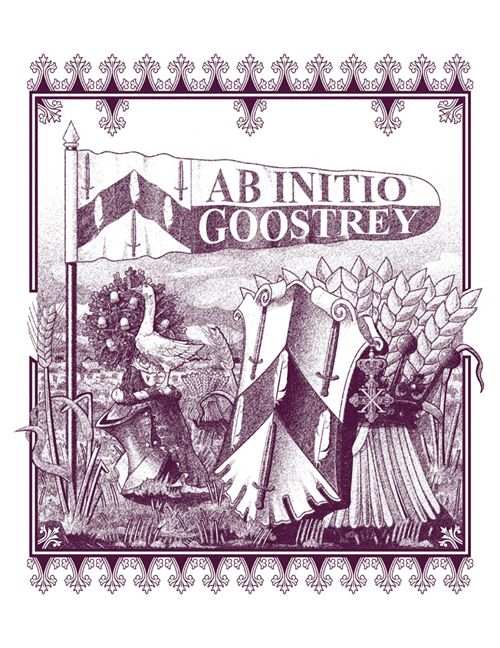
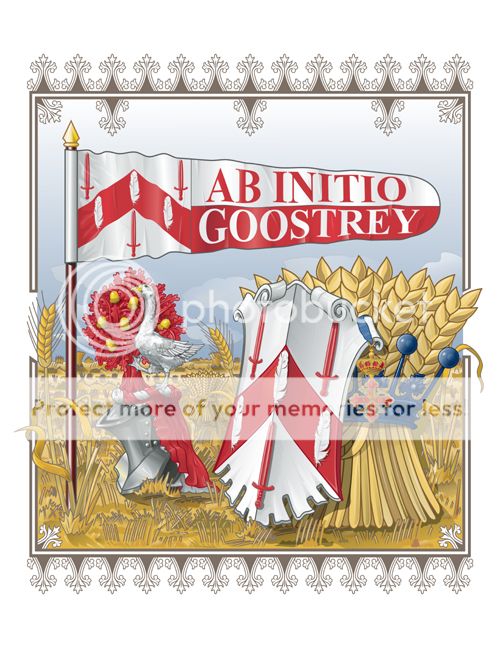
I am pleased to show off my new bookplate produced to my own design and interpreted by Ljubodrag Grujic (who was a delight to deal with).

The inspiration behind the design came from the bookplate of William Henry Weldon, when Norroy King of Arms. I asked Ljubodrag to create two versions, one in colour because I think that colour best imparts the message I wished to convey and one in black and white to compare with the Weldon bookplate which provided inspiration.

These are the two Goldstraw bookplates.


(These smaller images don't really do justice to Ljubodrag's excellent work).

The viewer is looking at a field of straw (stalks of threshed grain). This is a hidden rebus – straw is golden in colour. To the left of the bookplate at almost full height is a Garb encircled by the coronet of an English Earl (without the cap). This is to signify fealty to the Earls of Chester and is the badge/logo I adopted many years ago for my Cheshire Heraldry website. Leaning against the garb (on the left) is the Goldstraw shield and hanging from the top visible corner of the shield is the neck ribbon and cross of a Knight “jure sanguinis” of the Sacred Military Constantinian Order of St. George. The rest is, I believe, self explanatory.

My thanks to Ljubodrag.

Wednesday, 10 October 2012

November meeting cancelled.

A reminder to those who were at the September meeting of the Cheshire Heraldry Society and notice to those who weren't:

Unfortunately, due to a combination of a notification that the speaker is unable to attend and the regrettable double booking of the room, we have had to cancel the November meeting. Fortunately, Mr. Griffin has agreed to give us his talk on Goss China at a future date yet to be ascertained.

The Doubtful arms of Staffordshire - Weston and an elaborate fabrication

The final one of our five notes on the "Doubtful arms of Staffordshire" is that of  *Sir Symond Weston, of Lichfield. Ermine, on a...

Popular Posts